EDI Water Systems/Deionised / Demineralised
Industrial EDI Water Systems & Deionisation Services
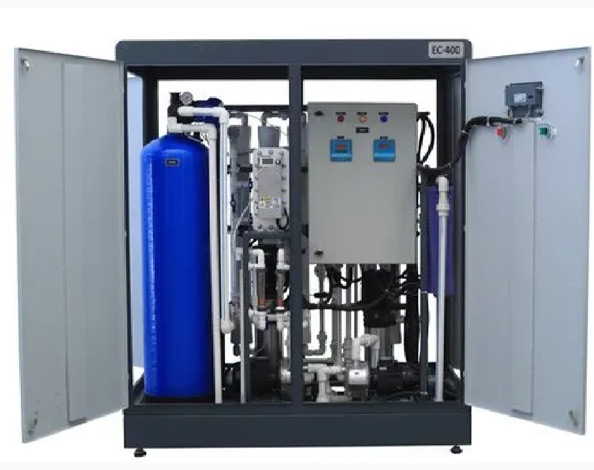
At One Eight Filtration, we design, install, and maintain high-capacity industrial water deionisation and Electro-Deionisation (EDI) systems across Ireland. Whether your facility requires consistent high-purity water for critical laboratory testing, validated pharmaceutical processes, or large-scale steam turbine generation, our solutions ensure total regulatory compliance and uninterrupted operational uptime.
We combine advanced engineering with 24/7 emergency service support to deliver reliable, bespoke ultra-pure water solutions tailored to your precise technical requirements.
What is Electro-Deionisation (EDI) Water Treatment?
Electro-Deionisation (EDI) is an advanced, continuous, and electrically driven water purification technology. By combining electricity, premium ion-exchange membranes, and specialised resin beds, EDI effectively removes ionised species, dissolved solids, and mineral impurities from your feed water supply.
Unlike traditional ion-exchange systems that require periodic shutdowns for harsh chemical regenerations, EDI systems run continuously and sustainably.
Key Benefits of EDI Systems:
-
Continuous Operations: Eliminates downtime by regenerating resins inline using an electrical current, ensuring a constant supply of high-purity water.
-
Chemical-Free Technology: Removes the need to store, handle, or neutralise dangerous chemicals like acid and caustic soda on your premises.
-
Consistently High Megohm Quality: Reliably produces ultra-pure water meeting the most stringent international standards ($>10 \text{ M}\Omega\cdot\text{cm}$ to $18 \text{ M}\Omega\cdot\text{cm}$ resistivity).
-
Reduced Operational Costs: Lowers power consumption and eliminates chemical disposal fees, offering a highly efficient return on investment.
Full-Spectrum Deionisation & Demineralisation Solutions
Every facility has unique water quality constraints. One Eight Filtration provides engineered solutions across the entire spectrum of ultra-pure water applications, utilizing both ion-exchange cylinders (DI) and electro-deionisation (EDI) modules.
| Application Type | Industrial Requirements | Our Technical Approach |
| Pharmaceutical & Life Sciences | Validated, sterile, pyrogen-free water meeting HPW/WFI standards. | Integrated RO-EDI loops with sanitisation controls and full IQ/OQ validation support. |
| Power Generation & Boiler Feed | High-pressure steam turbine protection, preventing silica and mineral scaling. | Heavy-duty demineralisation plants designed for maximum silica rejection and continuous feed. |
| Laboratory & High-Tech Manufacturing | Precision Type 1 and Type 2 water for analytics, microelectronics, and rinsing. | Compact, high-rejection EDI units with integrated UV and sub-micron filtration. |
Turnkey Support: From Specification to 24/7 Maintenance
An ultra-pure water system is only as reliable as the support network behind it. One Eight Filtration is a comprehensive, full-service provider, which means we support your infrastructure long after the initial installation.
-
Bespoke System Design: Engineered to match your exact inlet water analysis and peak flow rate demands.
-
Validation & Compliance Assistance: Documentation and testing support to assist with stringent industry audits.
-
24/7 Rapid Response Service: Our team of experienced service engineers is on standby around the clock, guaranteeing emergency breakdown assistance to protect your production lines.
-
Preventative Maintenance Contracts: Routine calibration, membrane cleaning, and resin monitoring to extend the lifespan of your EDI assets.
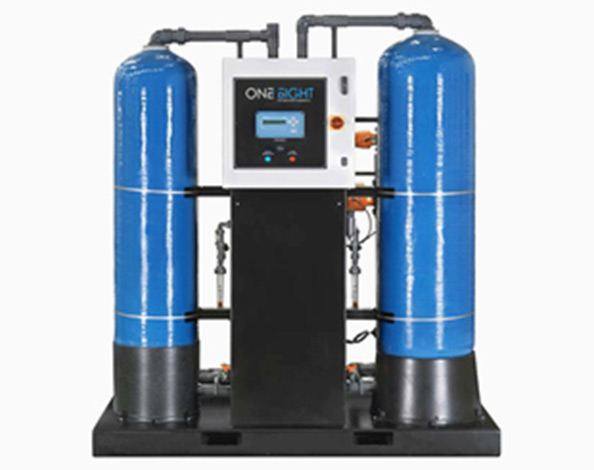
What is Demineralised Water?
Demineralised water (also known as demineralised water or DI water) is ultra-pure water from which virtually all dissolved mineral salts and inorganic ions have been removed.
While historical purification relied heavily on thermal distillation—where water is boiled in a still and condensed—modern industrial facilities utilise far more energy-efficient and scalable technologies. At One Eight Filtration, we design and install advanced ion exchange, electro-deionisation (EDI), and membrane filtration (Reverse Osmosis) systems that produce exceptionally high-purity water at a fraction of the operational cost of traditional distillation.
Demineralisation vs. Distillation: The Efficiency Advantage
For commercial and industrial applications, modern demineralisation processes offer significant advantages over old-school thermal distillation:
-
Superior Energy Efficiency: Distillation requires massive amounts of thermal energy to boil water. Membrane filtration and EDI rely on fluid hydraulics and electrical currents, drastically reducing energy consumption.
-
Continuous Production: Advanced EDI and automated ion-exchange plants operate continuously without the cooling downtime required by industrial stills.
-
Targeted Silica Rejection: Modern multi-stage demineralisation systems are explicitly engineered to target and eliminate volatile contaminants like reactive silica, which cause catastrophic scaling in high-pressure boilers.
Comprehensive Mineral & Ion Removal
Our advanced demineralisation systems produce water that is nearly 100% free of dissolved minerals, heavy metals, and salts. Removing these specific ionic species protects your downstream equipment from scaling, corrosion, and chemical interference:
Cations (Positively Charged Ions Removed)
-
Calcium (Ca^ 2+) & Magnesium (Mg^2+): The primary drivers of hard water scaling in boilers and heat exchangers.
-
Iron (Fe^3+) & Manganese ($Mn^2+): Heavy metals that cause severe fouling, discolouration, and piping blockages.
-
Sodium (Na^+) & Potassium (K^+): Highly soluble alkaline metals that must be eliminated for precise laboratory and pharmaceutical compounding.
Anions (Negatively Charged Ions Removed)
-
Alkalinity (CO_3^2-, HCO_3^-: Carbonates and bicarbonates that can break down to form corrosive carbon dioxide gas in steam systems.
-
Chlorides (Cl^-) & Sulfates (SO_4^2-): Highly corrosive ions that rapidly accelerate pitting corrosion in stainless steel pipework.
-
Nitrates (NO_3^-): Harmful inorganic compounds strictly regulated in food, beverage, and drinking water applications.
-
Silica (SiO_2): Non-conductive dissolved solids that form an incredibly hard, glassy scale on high-pressure steam turbine blades if not completely stripped during demineralisation.
Engineered Demineralisation Systems for Irish Industry
One Eight Filtration provides turnkey design, commissioning, and maintenance of high-purity water plants across Ireland. Our systems are built to achieve the exact conductivity and resistivity standards required by your industry guidelines, whether you are managing an energy-generation boiler or a validated medical manufacturing line.
How Demineralised Water Benefits Your Factory or Plant
For modern industrial plants and manufacturing facilities, source water quality directly impacts operational efficiency, equipment lifespan, and product integrity. Untreated or standard mains water contains dissolved minerals that, under thermal or chemical stress, precipitate out of solution to cause catastrophic equipment failure.
Implementing an advanced demineralisation system—achieving total dissolved solids (TDS) below 10 mg/l and an electrical conductivity less than 2 mS/m—delivers substantial commercial and operational benefits:
1. Eliminates Internal Scaling and Boiler Tube Failure
When hard water is heated in industrial boilers, heat exchangers, or cooling towers, minerals like calcium and magnesium form a thick, insulating layer of limescale.
-
The Cost: A mere 1mm of scale can increase boiler fuel consumption by up to 10% to 12% because the system must work harder to transfer heat.
-
The Solution: Demineralised water eliminates scale-forming ions entirely, maintaining optimum thermal heat transfer, lowering energy bills, and preventing localised overheating that causes boiler tube ruptures.
2. Prevents Corrosive Pitting and Asset Degradation
Dissolved anions like chlorides (Cl^-) and sulfates (SO_4^2-) are highly aggressive agents that penetrate the protective oxide layer of stainless steel and industrial alloys. This leads to pitting corrosion—highly localised, deep cavities that can cause sudden pipework and tank failures. Demineralised water strips out these aggressive ions, significantly extending the operational lifespan of expensive plant infrastructure.
3. Guarantees Product Consistency and Validated Standards
For high-precision industries such as pharmaceuticals, cosmetics, electronics, and food and beverage processing, any mineral variation in the process water can ruin an entire production batch.
-
Using water with a stable conductivity below 2 mS/m ensures that your process water acts as a completely neutral, predictable baseline.
-
This simplifies batch validation, meets strict European manufacturing standards, and protects your brand from product recalls.
Technical Consideration: Selecting the Right Technology for Your Facility
While demineralised water is highly pure, the method you choose to produce it determines whether it is safe for your specific application. As a plant operator, it is vital to understand the technical limitations of different filtration setups:
Ion Exchange and EDI Systems (Resin-Based)
-
How it works: Utilises charged resin beds to attract and trap mineral ions.
-
Limitation: Resins cannot remove uncharged molecules. Because organic matter, viruses, and bacteria carry no net electrical charge, they pass straight through ion exchange cylinders and EDI modules.
-
Best For: High-pressure steam boilers, power generation turbines, and closed-loop heating systems where mineral scaling is the sole threat.
Reverse Osmosis (RO) and Nanofiltration (Membrane-Based)
-
How it works: Forces water through a semi-permeable, microscopic physical membrane barrier.
-
Advantage: Because membranes reject contaminants based on physical size as well as charge, they successfully strip out organic contaminants, bacteria, and viruses alongside minerals.
-
Best For: Pharmaceutical compounding, medical device rinsing, food and beverage production, and laboratory applications where total biological sterility is mandatory.
The One Eight Approach: For facilities requiring the ultimate standard of ultra-pure, sterile water, we engineer multi-stage treatment trains. By placing a Reverse Osmosis system upstream to remove organics and the bulk of the minerals, followed by an Electro-Deionisation (EDI) module to polish the water, we deliver a completely sterile supply with unmatched electrical resistance

How is demineralised water beneficial for your factory/plant?
High-Purity Applications of Demineralised Water
Because of its exceptionally low conductivity and mineral-free profile, demineralisation is reserved for specialized industrial processes where even minor water impurities can lead to catastrophic asset failure or product contamination.
While demineralised water is utilized across countless bespoke applications, it is an absolute operational requirement in three core sectors:
-
Power Generation: Protecting high-pressure boilers and multi-million euro steam turbines from scaling and volatile gas corrosion.
-
Food & Beverage Processing: Serving as an ingredient-grade or final rinse water to maintain absolute biological safety and taste consistency.
-
Electronics & Semiconductor Manufacturing: Providing ultra-pure micro-rinse streams for sensitive circuit board fabrication where micro-particles cause component shorts.
Demineralised Water in the Power Industry
In the power generation and energy sector, demineralised water is the lifeblood of boiler feed water systems and continuous steam generation loops.
Modern power facilities operate high-pressure boilers to generate the high-velocity steam needed to drive power-generation turbines. As operating pressures increase, the boiler’s tolerance for dissolved solids drops to near zero. Any minerals present in the water will instantly bake onto internal surfaces, destroying heat-transfer efficiency.
[Mains / Well Water] ──> [Demineralisation Plant] ──> [High-Pressure Boiler] ──> [High-Velocity Steam] ──> [Turbine Power]
                                                                ▲                                               │
                                                                └─────────── [Condensate Return] ◄──────────────┘
                                                                           (Requires Degassing)
The Condensate Return Loop & The Danger of Dissolved Gases
During the steam generation cycle, steam passes through the turbines, cools, and condenses back into liquid water. This condensate return is collected and recycled back into the boiler feed water loop to save energy and water.
While this recycled condensate is technically distilled, it acts like a sponge for ambient gases as it cools, leading to severe chemical vulnerabilities:
-
Oxygen (O_2) Pitting: Dissolved oxygen in the feed water causes rapid, localized pitting corrosion on internal boiler pipes. This can burn through a heavy-gauge steel pipe in a remarkably short timeframe.
-
Carbon Dioxide (CO_2) Acidification: Dissolved carbon dioxide reacts with the water to form carbonic acid. This drops the pH of the condensate, causing systemic thinning and corrosion of the condensate return lines.
Integrating Advanced Degassing with Demineralisation
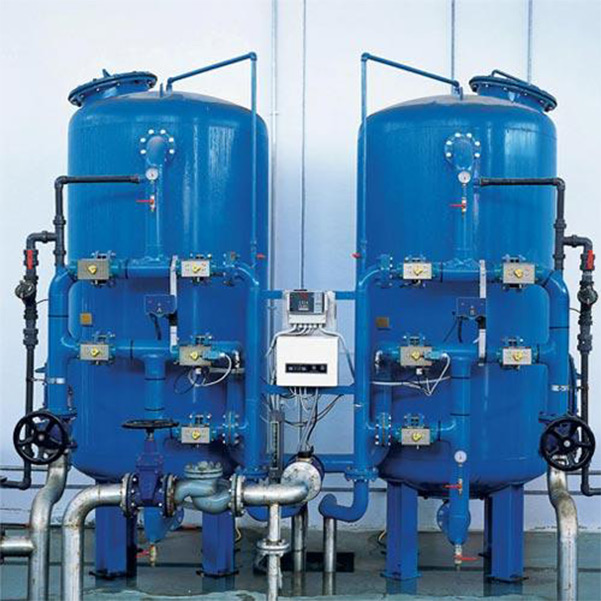
To prevent these aggressive chemical reactions from degrading your plant infrastructure, a standard demineralisation plant must be paired with advanced gas removal technologies.
At One Eight Filtration, we engineer comprehensive boiler feed systems that integrate:
-
Membrane Degassing Modules: Utilizing specialized hydrophobic membranes to strip out dissolved CO_2 and O_2 inline without chemicals.
-
Thermal Deaeration Devices: Using physical pressure and heat changes to force dissolved gases out of the feed water stream before it enters the boiler.
-
Chemical Oxygen Scavengers: Injecting precise, monitored chemical dosing to neutralize any remaining trace molecules of oxygen, guaranteeing total system protection.
Demineralised Water in Refineries
Much like the power generation sector, oil and gas refineries operate continuous, high-pressure thermal processes that rely on large-scale steam generation. In these volatile, high-temperature environments, relying on simple water softening is entirely inadequate.
While water softeners remove hardness ions like calcium and magnesium, they leave behind total dissolved solids (TDS) and alkalinity. In high-pressure refinery boilers, these remaining impurities will rapidly cause foaming, carryover, and catastrophic scaling across internal process streams.
[Raw Water Source] ──> [Pre-Treatment] ──> [Membrane Filtration (RO/NF)] ──> [Ion Exchange Polishing] ──> [Refinery Process Stream]
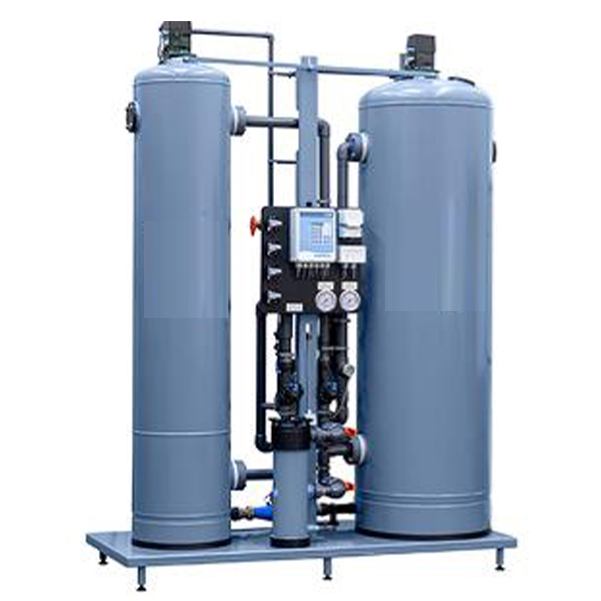
To prevent this asset degradation, refineries utilise a multi-stage demineralisation process, typically combining membrane filtration (Reverse Osmosis or Nanofiltration) with ion exchange polishing. This delivers ultra-pure feed water that meets the strict, low-tolerance contamination thresholds required by heavy-gauge refinery boilers.
Petrochemical and Chemical Plant Applications
Chemical manufacturing and petrochemical synthesis demand absolute process control. Beyond providing ultra-pure boiler feed water to drive chemical reactions, demineralisation plays a critical role in managing a facility’s thermal efficiency and environmental footprint.
Cooling Tower Blowdown and Wastewater Minimisation
Industrial cooling towers lose vast amounts of water through evaporation. As pure water evaporates, the minerals and dissolved solids left behind become highly concentrated. To prevent this concentrated water from scaling the cooling tower infrastructure, a portion of it must be bled off—a process known as cooling tower blowdown.
Managing this blowdown effluent presents two distinct commercial and regulatory challenges for petrochemical plants:
-
Environmental Compliance & Discharge Regulations: In Ireland, any industrial effluent returned to the environment or discharged into a publicly owned treatment works (POTW) must strictly comply with local municipal discharge regulations and Environmental Protection Agency (EPA) licences.
-
Rising Utility and Sewer Connection Fees: Discharging high volumes of mineral-heavy wastewater into municipal sewer lines can incur massive volumetric fees and heavy trade effluent charges.
The Financial Benefit of Demineralisation Systems
Integrating an advanced demineralisation or Reverse Osmosis system directly into your wastewater loop transforms a waste stream into an asset:
-
Water Recycling and Reuse: By processing cooling tower blowdown through a demineraliser, you strip out the highly concentrated salts and minerals, allowing the purified water to be safely recycled back into the plant.
-
Drastic Cost Reduction: Recycling your process water minimises the requirement to draw expensive new mains water and slashes your municipal sewer discharge volumes, avoiding heavy sewer connection and volumetric disposal fees.
-
Guaranteed Regulatory Compliance: Our tailored filtration systems ensure that any trace effluent that must leave your facility easily meets local municipal and EPA discharge thresholds, protecting your business from regulatory penalties.
Demineralised Water in the Food & Beverage Industry
In food and beverage production, water quality is directly tied to consumer safety, product shelf-life, and brand reputation. Because food safety regulations leave zero margin for error, facilities across Ireland require ultra-pure water at almost every stage of the manufacturing process.
From ingredient water blending to high-temperature equipment sanitisation, standard mains or well water is rarely pure enough. One Eight Filtration designs and installs high-purity demineralisation systems engineered to satisfy the most stringent food safety audits.
Key Applications in Food & Beverage Manufacturing
[Raw Water] ──> [Multi-Stage Membrane Filtration] ──> [Sterile Storage Loop] ──>  1. Product Ingredient Blending
                                                                                 2. Clean-in-Place (CIP) Sanitisation
                                                                                 3. Container Rinsing & Packaging
1. Sterile Container Rinsing & Packaging
Before any beverage or food product is filled, jars, cans, and bottles must be thoroughly rinsed to eliminate dust and chemical residues. Utilizing demineralised water ensures that containers dry completely spot-free, leaving no mineral film or white scaling that could alter the product’s appearance or taste.
2. Clean-in-Place (CIP) & Equipment Sanitisation
Process equipment, pasteurisers, and mixing vats must be regularly cleaned and sanitised using automated Clean-in-Place (CIP) cycles.
-
The Problem: Hard water minerals can react with cleaning chemicals, reducing their effectiveness and leaving a stubborn mineral scale inside stainless steel pipework where bacteria can hide.
-
The Solution: Demineralised water maximises the efficiency of sanitising agents, allows for lower chemical dosages, and ensures a pristine, sterile surface across all process loops.
3. Food Processing & Product Blending
Whether used as a direct ingredient in beverages or as a processing aid in food production, water must be a completely neutral baseline. Any variation in mineral content can alter product flavour, colour, and chemical stability.
Why Membrane Filtration is Mandatory for Food Safety
While traditional resin-based ion exchange effectively strips out minerals, it cannot remove uncharged biological contaminants. Because organic matter, bacteria, and viruses carry no net electrical charge, they can pass right through standard deionisation resin beds, creating a severe biohazard risk in a food facility.
To guarantee absolute compliance with European Union food safety standards, One Eight Filtration strictly implements membrane-based demineralisation technologies, including:
-
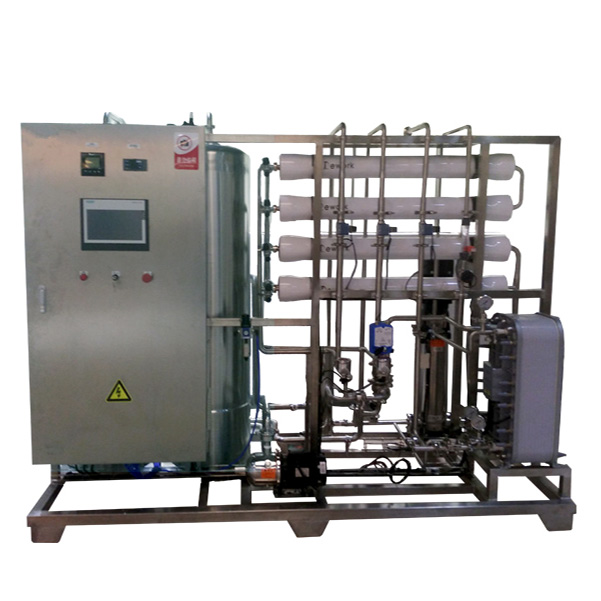
Reverse Osmosis (RO) Systems: Utilizing microscopic physical barriers to reject up to 99% of dissolved mineral salts while completely blocking organic molecules, bacteria, and viruses.
-
Nanofiltration (NF): Providing targeted organic material removal and partial demineralisation for specialized process streams.
-
Integrated UV Disinfection: Pairing membrane systems with downstream ultraviolet sterilisers to ensure the ultra-pure water loop remains completely sterile and pyrogen-free.
Pharmaceuticals and Cosmetics
Deionised and distilled water are used in the manufacturing of pharmaceutical products and cosmetics in order to control product quality and safety. Different methods of producing demineralised water for different uses such as rinsing and cleaning will be reverse osmosis or deionisation, while formulations typically use distilled water.
Other industries
Demineralised water are both used for cleaning and rinsing applications across a wide variety of industries, including chemical production, mining, also, solvents in applications as diverse as electrocoating, where they function as a carrier for paint solids or in research labs where they may be used to make a variety of solutions.

Contact Us
To find the best solution for your home or business, talk with one of our team today by filling in our form or calling us on +353 (0) 67 53 886
HEAD OFFICE
- Unit 17,
Springfort Business Park,
Nenagh,
Co Tipperary,
E45YK70 - +353 (0) 67 53 886
- info@oneeight.ie
For more information on our products, please do not hesitate in contacting us.